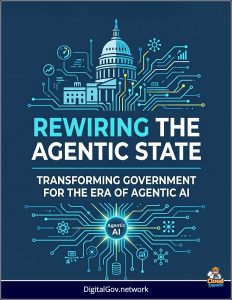
Rewiring the Agentic State: How a Small Insurgent Team of AI Engineers is Transforming the British Civil Service
Governments must rewire for agentic AI—autonomous systems that plan and act independently—to boost efficiency, services, and crisis response.

 The United Kingdom’s public sector faces a severe productivity crisis.
With an NHS waiting list of 7.25 million people, a backlog of around 350,000 court cases, and only one in five planning applications decided on time, the machinery of state appears stuck in institutional inertia.
For Eoin Mulgrew and the Number 10 Data Science team (10DS), these are not isolated failures but symptoms of a deeper issue in a workforce of roughly 400,000. Research from the Tony Blair Institute points to a potential £40 billion annual productivity gain through effective AI adoption—enough to meaningfully reshape the UK’s economic outlook.
10DS emerged from pandemic-era needs and has grown into a bold experiment in modern statecraft. Rather than incremental tweaks, the team pursues a Silicon Valley-inspired overhaul of government operations, treating the civil service as a legacy system ready for disruption. Their approach is not about replacing civil servants but augmenting and rewiring how the state functions at speed.
The Insurgency Model: Turning the Oil Tanker
The traditional civil service resembles a massive oil tanker—essential yet slow to maneuver. Standard recruitment, procurement, and hierarchical processes move at a glacial pace ill-suited to the AI era. 10DS operates as a “scrappy, insurgent unit” at the heart of government, empowered by direct political backing from Number 10. This mandate allows the team to bypass many constraints, enter departments opportunistically, and ship solutions rapidly.
Key features of this model include market-rate pay (competitive though not Meta-level), recruitment exclusively from outside the civil service, and a focus on high-autonomy execution. The team does not wait passively for requests; it identifies high-impact opportunities to demonstrate what is possible when technical talent is unshackled.
Recruiting Missionaries, Not Mercenaries
10DS maintains an extremely selective hiring bar, with an acceptance rate of just 0.7–0.8%. Candidates are drawn from Y Combinator founders, serial entrepreneurs, elite research labs, and big tech—individuals impatient to make a systemic difference. The pitch emphasizes “impact equity”: the chance to shape decisions that affect millions, far beyond optimizing ads or incremental products.
As Mulgrew notes, a paycheck alone won’t sustain motivation through tough challenges. The team seeks “missionaries” driven by the scale of public problems. In return, they offer autonomy and direct access to the levers of state power. This outsider-only approach deliberately avoids the generalist culture of traditional civil service hiring.
Rapid Delivery: From Weeks, Not Years
Government projects often linger in lengthy “discovery” phases. 10DS targets two-week cycles for meaningful progress on low-hanging but high-value problems.
A striking example is the legal analysis tool. The Cabinet Office faced a £1.5 million quote from an external law firm to analyze the UK statute book—described as a “mountain of text the height of four African elephants.” One embedded 10DS engineer worked with in-house lawyers for two weeks, delivered a working tool, and handed it over for ongoing use. It not only saved money but runs faster than the pace of new legislation.
Other early wins include:
- Policy Simulator: Tools enabling teams to model real-world impacts of decisions (e.g., Universal Credit changes) before rollout, moving beyond intuition.
- Delivery Red-Teamer: A “PMO in the pocket” that scrutinizes departmental reports for optimism bias, assesses proposed mitigations, and offers independent judgment.
- Extract: A collaboration with Google DeepMind using Gemini to digitize complex planning applications, including handwritten notes and maps, addressing a major drag on economic growth.
Forward Deployed Engineers: Keys to the State
The most radical element is the Forward Deployed Engineer (FDE) model. Elite talent is embedded directly with frontline teams, policy advisers, and operational staff to observe workflows and co-create solutions.
A vivid illustration is “Will,” a recent Harvard dropout and YC founder. Weeks after leaving California, he stood outside HMP Wandsworth in the rain, holding the prison keys, tasked with using AI to stem drug flows and enhance safety. This hands-on approach extends to education (benchmarking AI tutors for cognitive load and equity) and other domains. Engineers are told: come do great work in industry, then take the keys to the state and see what you can achieve.
Scaling from Hack to Horizontal Transformation
Mulgrew candidly describes 10DS as a temporary “hack” to bypass systemic barriers. The 12–24 month vision is broader: transition these practices into business-as-usual across government. This means shifting from targeted pilots to horizontal improvements affecting the entire 400,000-strong workforce.
Priorities include automating police transcription (a major time sink), enhancing efficiency in large call centers at the Department for Work and Pensions (DWP) and HM Revenue and Customs (HMRC), and seeding specialized AI units elsewhere. Partner initiatives include the Incubator for AI (i.AI) in DSIT, the AI Safety Institute, Justice AI in the Ministry of Justice, and education-focused efforts.
The team also promotes radical transparency via public dashboards tracking delivery against goals, such as the AI Opportunities Action Plan—unprecedented visibility for Whitehall.
Lessons and the Path Forward
10DS demonstrates that a small, high-caliber team with political cover, market-aligned incentives, and operational freedom can deliver outsized results quickly. Cost savings, faster processes, and new capabilities prove that AI can meaningfully address long-standing inefficiencies.
Yet challenges remain. Scaling an insurgency into systemic change requires cultural shifts, sustained leadership, and addressing deeper structural issues in civil service incentives and risk aversion. International collaboration—with efforts like the US Digital Service—can help refine approaches and benchmarks.
The core question is compelling: with £40 billion in potential gains on the table and proof that rapid, high-impact delivery is possible, what prevents wider adoption of this mindset? Turning the oil tanker will demand more than one unit. It requires embedding the insurgent spirit—agility, technical excellence, and mission focus—throughout the state.
In an age of powerful AI, governments that successfully rewire themselves stand to deliver better services, restore public trust, and unlock significant economic value. The 10DS experiment offers a practical blueprint for how to begin that transformation—one embedded engineer, two-week sprint, and high-stakes problem at a time.