The Agentic State: A Vision for Government Transformed by Agentic AI
Agentic AI shifts government from static portals to proactive, multi-agent systems that orchestrate workflows, deliver fast outcomes, and enable an efficient "Agentic State" beyond legacy bureaucracy.

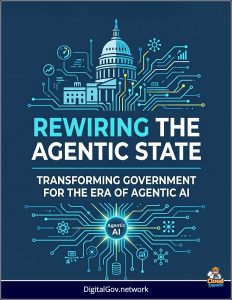 The future of government requires more than digital portals—it needs a brain and hands.
Agentic AI represents a profound shift from passive, form-based systems to proactive, autonomous ones capable of pursuing goals, orchestrating workflows, adapting in real time, and acting across domains.
Governments that embrace this transformation can close the widening efficiency gap with the private sector, deliver better outcomes, and maintain relevance in an era of exponential technological change.
This report The Agentic State, offers a vision for implementing this new paradigm, a global action platform designed to help governments harness agentic AI, autonomous systems that can perceive, reason, plan, and act toward goals with minimal human intervention.
The Agentic State Vision
Initiated by the Global GovTech Centre and supported by the World Bank, The Agentic State argues that agentic AI will disrupt government operations faster than any previous technology. It calls for urgent, values-driven adoption to improve services, decision-making, and accountability while positioning states as ethical leaders. The report emphasizes equitable access for nations at varying levels of digital maturity.
Agentic AI represents a leap beyond narrow tools. These systems handle complex, multi-step tasks independently—managing citizen inquiries end-to-end, running real-time crisis simulations, or optimizing procurement. The vision is for “agentic states” characterized by greater autonomy, adaptability, and public focus. Key applications include:
- Public Services: AI agents providing personalized, proactive support, such as dynamic welfare allocation and significantly reduced waiting times.
- Crisis Management: Real-time scenario modeling for rapid, data-driven responses to pandemics, disasters, or other emergencies.
- Governance: Enhanced policy simulation, transparent AI audits, and stronger accountability.
- Procurement and Infrastructure: AI-optimized sourcing to lower costs and improve efficiency.
The report highlights necessary transformations across technology (robust infrastructure), organizations (new roles like “AI stewards”), and leadership (cross-sector collaboration). Projections suggest agentic AI could boost global GDP by 15-40% by 2035, with governments potentially achieving up to 20% efficiency gains—provided risks like bias, inequity, or over-centralization are addressed.
Recommendations include AI sandboxes for safe experimentation, upskilling public servants, and forming international coalitions for standards.
The Expectation Gap and Legacy Limitations
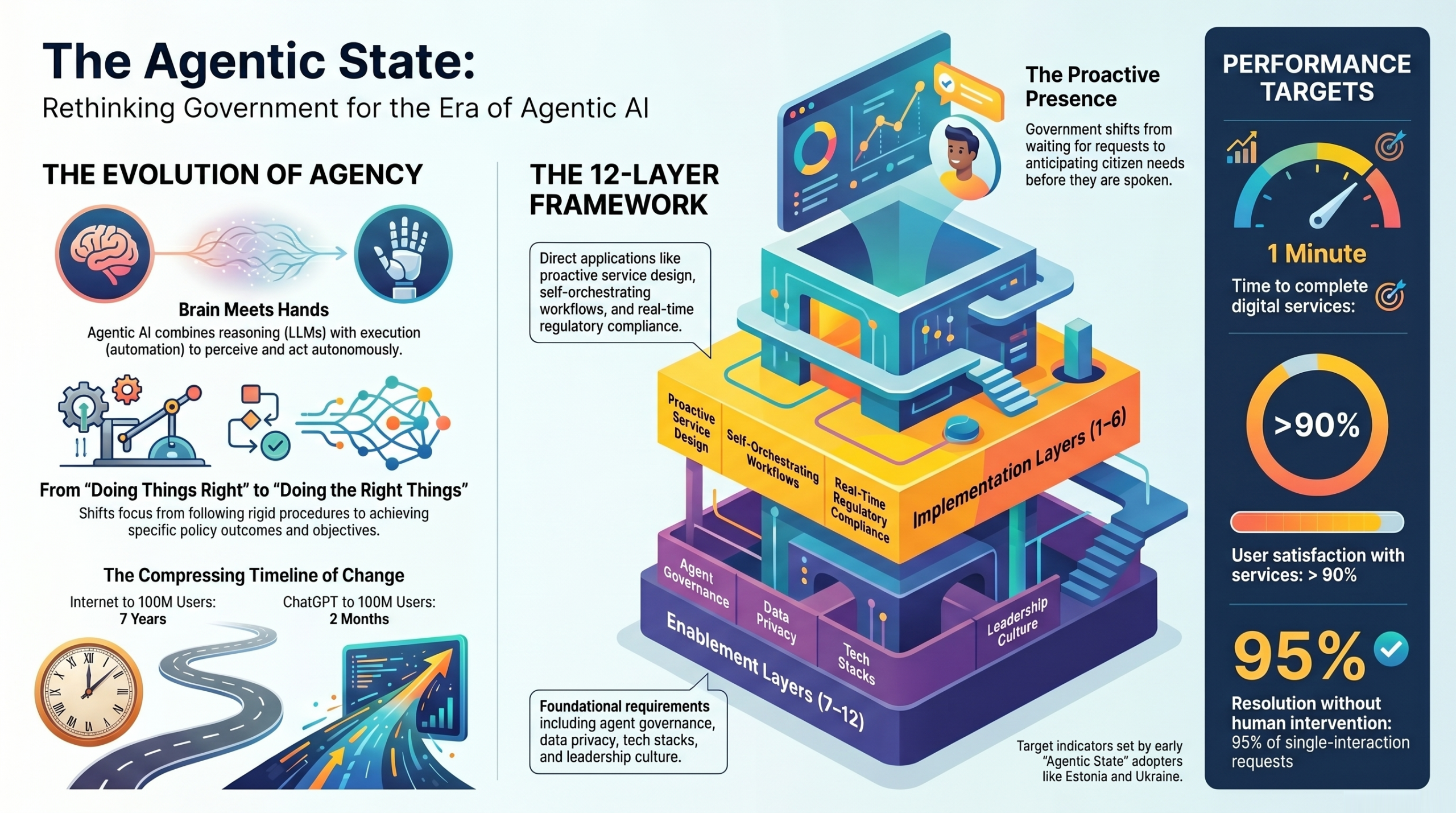
Technological adoption has accelerated dramatically. While the telephone took 75 years to reach 100 million users, ChatGPT achieved the same in just two months. Citizens now enjoy seamless private-sector experiences but encounter fragmented government portals that require repeated data entry, navigation of silos, and endurance of human bottlenecks.
This creates a crisis of relevance: a “vicious cycle of limited digital capacity” where legacy systems and paper-based mindsets deter top talent, further hindering modernization.
|
Traditional bureaucracy excels at procedural compliance (“box-ticking”) but often fails to deliver strong social outcomes. The Agentic State breaks this by prioritizing outcome-driven orchestration. Instead of rigid processes, government sets clear goals—such as approving 90% of construction permits while upholding climate standards—and empowers AI agents to dynamically reconfigure pathways based on real-world feedback.
A compelling example comes from Goiás, Brazil, where AI agents for project analysis slashed review times for innovative projects from one year to one week and reduced required staff by 33 people. This model supports better public service design around life events, rapid crisis response across agencies, and efficient procurement within policy guardrails.
What Makes AI “Agentic”?
Agentic AI combines the “Brain Stream” (large language models for reasoning) with the “Hands Stream” (tools like robotic process automation for execution). The real power emerges in multi-agent systems, where specialized agents collaborate in a division of labor: a planner outlines steps, an executor interacts with APIs or systems, and a verifier ensures compliance with policies and rules. This architecture builds reliability essential for public sector trust.
Ukraine offers an inspiring vision. As stated by Mykhailo Fedorov, First Vice Prime Minister and Minister of Digital Transformation: “The Digital State was our first step. The next is an Agentic State… Ukraine has already launched Diia.AI, the world’s first national digital agent that provides government services.” A single request or voice message can bridge a citizen’s need to results.
Performance Targets for the Agentic State
The Agentic State redefines expectations with ambitious yet achievable benchmarks that represent a new baseline for democratic legitimacy:
- 1 minute to complete most digital services
- 1 day to launch new digital services
- 90% reduction in human effort on routine correspondence
- 95% of single-interaction requests resolved without human intervention
- >90% user satisfaction with public services
These targets shift focus from internal processes to citizen outcomes.
Ukraine: Building the First Agentic State in Wartime
Ukraine is pioneering this vision under extreme conditions. Facing ongoing military pressure and resource constraints, its “adoption-first” AI Strategy 2030 prioritizes rapid implementation—“learning by doing”—to enhance resilience, drive reconstruction, and achieve technological sovereignty. A digitally native population, with around 70% of children aged 10–17 already using AI, provides a solid foundation.
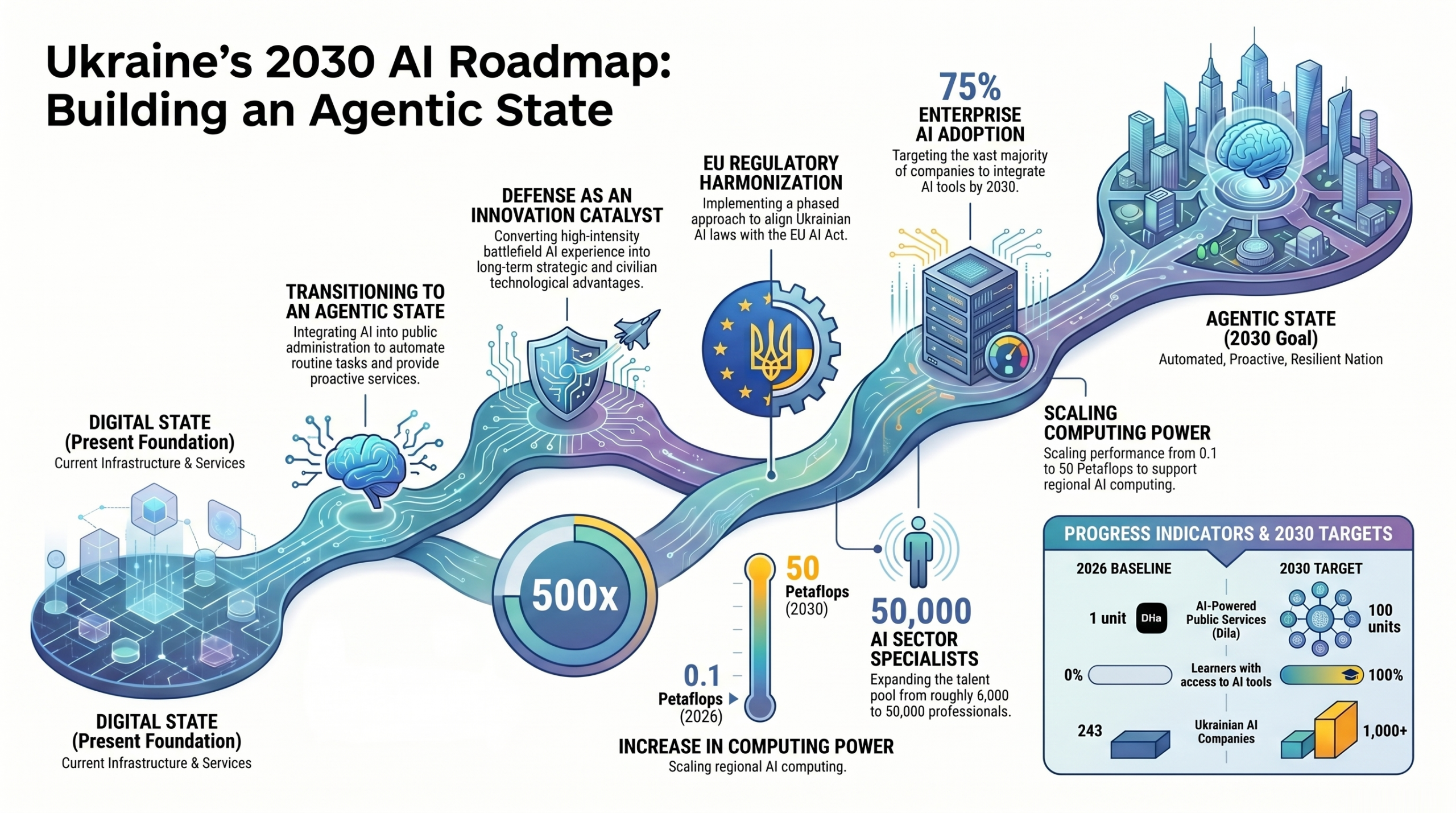
Building on the successful Diia digital platform, Ukraine is evolving from e-governance to a true Agentic State. The government aims to function as a high-performance platform rather than a rigid bureaucracy. An “Agentic GovStack” will transform Diia into a proactive AI assistant capable of managing complex workflows autonomously. Routine tasks shift to intelligent systems, freeing humans for strategic work and enabling seamless public-private integration.
Defense Innovation Under Fire
War has accelerated progress. The strategy establishes the “World’s First Defence AI Factory,” directly connecting private innovation to battlefield needs. Priorities include “deterrence through denial” via unmanned systems, geospatial intelligence, and logistics. Ukraine targets dramatic compression of the sensor-to-shooter cycle (under eight weeks for deployment) and has achieved 80–90% interception rates in key air defense scenarios. Low-cost autonomous solutions prove highly effective against expensive threats.
Sovereign Capabilities
Language and data are national security priorities. Ukraine aims for 200 billion high-quality Ukrainian-language tokens by 2030 to develop sovereign LLMs, reducing cultural bias and external influence. The “Nuclear-Powered AI” initiative plans protected underground data centers near nuclear facilities, targeting 50 petaflops by 2030 for resilient, sovereign compute.
Broader Transformation
Enterprise AI adoption is currently low at 4.6%; the goal is 75% by 2030, supported by Digital Maturity Audits and ready-made AI stacks. Regulation follows a phased EU AI Act-aligned approach with initial sandboxes. In education, AI tools personalize learning while shifting focus to critical thinking. The strategy unfolds in stages: defense foundations, public administration and economic integration, and global competitiveness.
Rewiring the Agentic State: Platform and Blueprints
Building the Agentic State requires deliberate institutional evolution, not blind automation or vendor dependency. Two integrated programs form the core:
- Sovereign AI Platform Design: A secure, federated architecture with shared standards for interoperability, auditability, safety, and data sovereignty. It includes identity management, agent orchestration, simulation environments, monitoring tools, and secure compute. Guardrails embed constitutional principles and human oversight by design, enabling departments to deploy specialized agents while reducing duplication and accelerating deployment.
- Use Case Blueprints: Standardized, replicable templates for high-impact applications (e.g., adaptive permitting, predictive infrastructure maintenance, personalized social services, automated compliance, crisis coordination). Each blueprint covers workflows, data needs, metrics, legacy integrations, risks, and change management—designed for adaptation across jurisdictions while preserving accountability and equity.
These create a virtuous flywheel: the platform provides governed infrastructure, while blueprints deliver quick wins and iterative learning.