 In the previous blog we explore the potential for Blockchain to form the foundation of a nation’s digital economy, enabling and securing transactions for industries like real estate.
There we reference Dubai’s Land Department launching their ‘Prypco Mint’ for this purpose, and in this article and the feature video we explore this same strategy for the USA.
This is especially timely as President Trump has taken steps to massively accelerate America’s expansion into this type of technology.
Most notably the ‘Deploying American Blockchains Act’ of 2025 mandates the U.S. public sector, led by the Department of Commerce, take a proactive role in blockchain adoption through policy development, stakeholder collaboration, and the establishment of best practices.
Passed by the U.S. House on June 24, 2025, and now under Senate review, the Act positions the Department of Commerce as the lead advisor to the President on blockchain policy, tasking it with developing a national strategy to advance blockchain and distributed ledger technology (DLT).
This legislation requires the public sector to establish a Blockchain Deployment Program to coordinate federal efforts, promote innovation, and support open-source infrastructure, with a seven-year timeline for implementation.
Accelerating the American Digital Economy
The digital economy is booming, and the United States stands at the forefront of this transformation.
Like the Dubai example deploying a certain combination of technologies makes possible complete solutions for a wholesale move from the ‘traditional’, ie paper-based legalities, to a 21st century digital economy. In real estate for example streamline processes such as title transfers, escrow agreements, and contract execution by ensuring that all parties are legitimate and their credentials are tamper-proof.
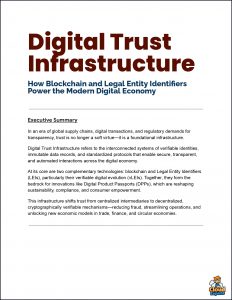
As global markets increasingly rely on secure, transparent, and efficient systems, blockchain-based Verifiable Legal Entity Identifiers (vLEIs) offer a game-changing opportunity for the US government to supercharge its economic infrastructure. By harnessing the power of blockchain technology, the US can enhance trust, streamline operations, and position itself as a leader in the global digital economy.
The Power of Blockchain vLEIs
At the heart of this transformation lies blockchain-based vLEIs, digital credentials that verify the identity and authority of entities in a tamper-proof, decentralized manner.
Unlike traditional identification systems, vLEIs leverage blockchain’s immutability and transparency to ensure that every transaction, contract, or interaction is secure and verifiable. Managed under frameworks like the Global Legal Entity Identifier Foundation (GLEIF), vLEIs are poised to become the gold standard for digital trust across industries, from finance to supply chains to government services.
For the US, adopting vLEIs means creating a robust, future-proof system that enhances security, reduces fraud, and accelerates economic activity. Imagine a world where businesses, citizens, and government agencies can interact seamlessly, confident that every party is legitimate and every transaction is transparent. This is the promise of blockchain vLEIs, and the US government has a unique opportunity to lead the charge.
Transforming Government Operations
The US government can harness blockchain vLEIs to modernize its operations, making public services faster, more secure, and more accessible.
For instance, federal agencies could use vLEIs to streamline procurement processes, ensuring that only verified vendors participate in government contracts. By integrating vLEIs with smart contracts—self-executing agreements coded on the blockchain—the government could automate payments, reduce administrative overhead, and eliminate costly errors.
In the realm of public records, blockchain vLEIs could revolutionize systems like business registries, tax filings, and licensing. A decentralized, vLEI-verified database could ensure that businesses are properly registered and compliant with regulations, reducing the risk of fraud and enabling real-time audits. For example, the Internal Revenue Service (IRS) could use vLEIs to verify the identities of taxpayers and businesses, streamlining tax collection and combating tax evasion.
Boosting the Digital Economy
Beyond government operations, vLEIs can turbocharge America’s digital economy by fostering trust in digital commerce. Small and medium-sized enterprises (SMEs), which form the backbone of the US economy, often face challenges proving their legitimacy in global markets.
vLEIs provide a standardized, globally recognized credential that levels the playing field, allowing American businesses to compete internationally with confidence. From e-commerce platforms to cross-border trade, vLEIs ensure that every transaction is backed by verified identities, reducing the risk of fraud and building consumer trust.
The financial sector, a cornerstone of the US economy, stands to gain immensely. Blockchain vLEIs can enhance Know Your Customer (KYC) and Anti-Money Laundering (AML) processes by providing a secure, reusable digital identity for financial institutions and their clients.
This not only reduces compliance costs but also speeds up onboarding, enabling faster access to financial services for businesses and consumers alike. The Federal Reserve could explore vLEI integration to secure digital payments or even support the development of a central bank digital currency (CBDC), positioning the US as a leader in digital finance.
Strengthening National Security and Cybersecurity
In an era of rising cyber threats, blockchain vLEIs offer a powerful tool for safeguarding America’s digital infrastructure. By ensuring that only verified entities can access critical systems, vLEIs can protect government agencies, businesses, and citizens from cyberattacks and identity theft.
For instance, the Department of Homeland Security could use vLEIs to secure supply chains, verifying the authenticity of suppliers and preventing counterfeit goods from entering the market. Similarly, vLEIs could bolster cybersecurity in critical infrastructure sectors like energy and telecommunications, where trust is paramount.
The Role of the US Government
To unlock the full potential of blockchain vLEIs, the US government must take bold, proactive steps. First, it should establish a national framework for vLEI adoption, working with organizations like GLEIF to ensure interoperability with global standards. This could involve creating a federal task force to oversee vLEI implementation, setting clear guidelines for issuance, verification, and integration across industries.
Second, the government can lead by example, integrating vLEIs into its own systems. Pilot programs in agencies like the Small Business Administration or the Department of Commerce could demonstrate the technology’s value, encouraging private-sector adoption. Grants or tax incentives for businesses that adopt vLEIs would further accelerate uptake, particularly among SMEs.
Finally, the US can position itself as a global leader by championing vLEIs in international forums. By collaborating with allies and setting standards for blockchain-based identity systems, the US can shape the future of the digital economy, ensuring that American businesses and consumers remain competitive in a rapidly evolving landscape.
While the potential of blockchain vLEIs is immense, challenges remain. Regulatory clarity is critical to ensure that vLEIs are legally recognized and enforceable. The government must work with stakeholders to address privacy concerns, ensuring that vLEIs comply with data protection laws like the California Consumer Privacy Act (CCPA). Additionally, investments in blockchain infrastructure and digital literacy will be essential to ensure widespread adoption, particularly in underserved communities.
A Call to Action
The United States stands at a crossroads. By embracing blockchain vLEIs, the government can accelerate America’s digital economy, fostering trust, efficiency, and innovation across sectors.
From streamlining government services to empowering businesses and protecting national security, vLEIs offer a path to a brighter, more connected future. The time to act is now—by investing in this transformative technology, the US can lead the world into a new era of digital trust and prosperity.
Let’s seize this opportunity to build a stronger, more resilient digital economy. Blockchain vLEIs are not just a tool—they’re a catalyst for America’s next great leap forward.