AI-Powered Government: How the Universal Chatbot Is Finally Closing the “Wrong Door” Era
Universal AI chatbots are creating true 'No Wrong Door' government—citizens get answers across agencies in ONE conversation.

 Ai will transform Governments, dramatically improving their efficiency and citizen service.
The humble chatbot will act as the catalyst for this improvement.
Not because a chat interface is especially radical, but when its adoption is combined with a back-end initiative to federate a vast estate of information into the knowledge base that powers its answers.
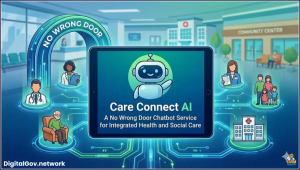
This is where the magic lies. A universal chatbot can act as a ‘No Wrong Door’ gateway, such that no matter which website a citizen uses to engage with it, the Q&A can span back across multiple departments, multiple organizations, individual experts’ knowledge, and more, so that the AI agent can surface the truly most useful answer to a vast array of potential questions, all in a matter of seconds.
The “No Wrong Door” Promise: One Conversation, Every Department
This “No Wrong Door” principle—already being piloted and praised in places like Washington, D.C., British Columbia during its COVID-19 response, and various U.S. federal data initiatives—eliminates the frustration of being bounced between agencies or siloed websites.
Citizens no longer need to know which department “owns” their issue; they simply ask, and the federated knowledge base delivers.
Behind the scenes, Retrieval-Augmented Generation (RAG) techniques, combined with secure data lakes and interoperability standards, pull from disparate sources—tax records, health eligibility rules, permitting databases, even real-time updates from local services—while maintaining strict privacy controls, audit trails, and human oversight for sensitive matters.
The efficiency gains are profound. Routine inquiries that once tied up call centers or email queues for days now resolve instantly and at scale. For instance, local governments using advanced AI chatbots have reported handling 90% of administrative interactions without human intervention, slashing wait times and operational costs.
From Reactive to Proactive: Real-World Efficiency Gains and Agentic Evolution
In Maryland, a Claude-powered virtual assistant launched in 2025 helped residents apply for benefits, track applications, and even discover additional programs they qualified for, contributing to record distributions like SUN Bucks food support.
Similar tools in states like Missouri (vital records chatbot) and California (tax and benefits navigation) demonstrate how conversational AI reduces errors, boosts completion rates, and frees public servants for complex, high-value casework.
Beyond answering questions, these systems evolve into proactive agents. As knowledge federation matures, AI can anticipate needs: reminding a family about expiring benefits, flagging eligibility for new programs based on life events, or pre-populating forms with verified data.
In 2026, we’re seeing the early shift toward “agentic” AI—systems that don’t just respond but act, routing requests across departments, initiating workflows, and coordinating outcomes with minimal human touch. This transforms government from a reactive bureaucracy into a responsive partner in citizens’ lives.
Building Trust in the AI Era: Governance, Privacy, and the Human Backstop
Of course, this transformation isn’t without challenges. Data silos, legacy systems, and varying privacy regulations must be addressed through deliberate federation efforts—think centralized yet secure repositories, common APIs, and ethical AI frameworks like those promoted by the U.S. GSA’s AI Community of Practice.
Trust remains paramount: answers must be accurate, transparent (with clear sourcing), and bias-mitigated, backed by human review loops for high-stakes decisions. Governments that invest in robust governance, workforce upskilling, and citizen co-design will reap the greatest rewards.
The result? Dramatically more efficient operations, higher citizen satisfaction, and resources redirected toward innovation rather than administration.
The humble chatbot, powered by a truly unified knowledge ecosystem, isn’t just improving service delivery—it’s redefining what effective, accessible government can be in the AI era. As adoption accelerates in 2026 and beyond, the gap between private-sector digital experiences and public-sector ones will finally begin to close, putting citizens at the true center of government.