Designing the Central ‘Data Hub’ for Care Connect AI
A "single version of the truth" is the foundation for Ai-powered social service transformation, unifying information from across multiple agencies into an intelligent chatbot interface.

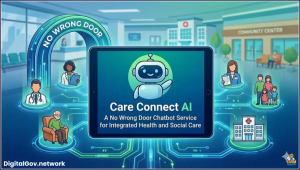 The “magic” of Care Connect AI won’t come from the AI but rather the joining up of multiple agencies and the sharing of their data.
Certainly AI will function as a hyper intelligent synthesizer of this data so that it can respond to chatbot questions with well matched answers that directs users to the correct services and information across a vast complexity of multiple agencies and non-profits.
But without that federated knowledge base, an AI isn’t actually that intelligent. First generation web site chatbots will demonstrate this, like the Bristols ‘Briz‘, where it can only field rudimentary ‘what time is bin collection’ type questions.
If someone says “I’m experiencing depression and alcoholism, and facing eviction”, it will be well beyond the capability of these simple chatbots, which will only be able to escalate to a call centre agent, who in turn will also be unlikely to be qualified for such a challenging social need, and will call upon the suitable equipped departments such as social services.
And ergo we are in to the heart of the design goal for Care Connect Ai, how to develop a more sophisticated capability to mirror and indeed improve upon this core function of social government. Imagine an agent that can instantiate this level of intimate, caring expertise, that can respond in seconds and marshall a knowledge spanning multiple agencies, people and services.
Data Hubs and Master Data Management
Building these types of unified data sources isn’t a new challenge or activity for government, where building a single view of citizen data has long been a core ideal to underpin digital transformation. For example the Improvement Service has implemented a ‘Data Hub’ to help councils join up care across Scotland.
This “No Wrong Door” principle—already being piloted and praised in places like Washington, D.C., British Columbia during its COVID-19 response, and various U.S. federal data initiatives—eliminates the frustration of being bounced between agencies or siloed websites.
Citizens no longer need to know which department “owns” their issue; they simply ask, and the federated knowledge base delivers.
Behind the scenes, Retrieval-Augmented Generation (RAG) techniques, combined with secure data lakes and interoperability standards, pull from disparate sources—tax records, health eligibility rules, permitting databases, even real-time updates from local services—while maintaining strict privacy controls, audit trails, and human oversight for sensitive matters.
Azure Data Management
Cloud vendors like Microsoft also bake in this type of capability to their services.
The benchmark for this integration is Liverpool City Council, which utilized cloud-based Master Data Management (MDM) to create a comprehensive view of resident vulnerabilities. By moving from historical reporting to active forecasting, the council turned fragmented records into a strategic data asset.
Building this asset requires the automated integration of 35 core data feeds from across agency silos. The process involves ingesting data from diverse sources (e.g., police, healthcare, schools, housing) into an Azure Data Lake.
Within the Sentinel Data Platform, technologies like Azure Synapse Analytics utilize Python and Java to match records and execute risk measure calculations. This unified asset integrates specific sub-projects such as the SAFE Taskforce and the Vulnerable Pupils initiative, ensuring that data from mental health practitioners and youth offending teams informs a single citizen profile.
The impact of data matching is transformative. In Liverpool, the implementation of the Sentinel Data Platform on Azure identified a target cohort of vulnerable families that was 193% larger than previously identified through manual processes. This allowed Early Help teams to immediately target interventions for over 4,000 families, providing support before they reached a crisis state.
Conclusion
The Central Data Hub represents the foundational infrastructure that will unlock the full potential of Care Connect AI. By establishing a secure, federated “single version of the truth” — drawing together disparate data from health, housing, social services, education, and beyond — governments can move beyond fragmented silos toward truly integrated, proactive care.
This unified data asset does more than power intelligent chatbots or Retrieval-Augmented Generation pipelines; it transforms how care professionals make high-stakes decisions, how resources are allocated, and how crises are anticipated rather than merely reacted to.
As governments continue to invest in Ai technologies, the promise is clear: citizens will no longer need to navigate bureaucratic mazes or repeat their stories across departments. They can simply ask for help, confident that the system behind the answer understands their full context and can guide them to the right support at the right time.