Tell Us Once – Ushering in a New Paradigm of ‘Live Data’ Digital Government Services
"Tell Us Once" revolutionizes digital government by enabling citizens to share data like address changes once, automatically syncing it across all agencies via a secure Data Services Network.

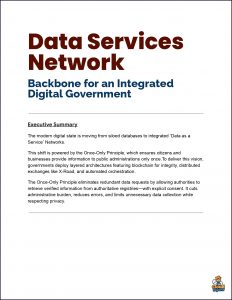 The ideal of ‘Tell Us Once’ entirely encapsulates the goals of Digital Government, and abstracts deep complexity into the most simplistic form possible.
As the term suggests it’s a systems design where users can input an update, for example a change of address, and that update is replicated globally such that the user never needs to repeat the process again.
We propose this system design can be described as a ‘Data Services Network‘, the architecture central to a new paradigm of ‘live data’ Digital Government, where ‘Tell Us Once’ updates are replicated across all agencies.
For governments this is a straight forward dynamic, it’s every public sector body: Local, National, Healthcare – All of these bodies deal with the same citizen, all of them repeat data storing like postal address, so that they can communicate with those people.
For most citizens, interacting with the state is a exercise in bureaucratic redundancy. We have all felt the frustration of being the “human courier” for our own data—navigating a maze of siloed agencies to provide the same name, address, and date of birth repeatedly. This friction isn’t just an inconvenience; it represents a fundamental failure in the “request-response” model of 20th-century governance.
The “Once-Only” Revolution: From Silos to Orchestration
The antidote is the “Once-Only” principle: the strategic mandate that individuals should only provide information to a public administration once, with that data subsequently shared and reused under strict protocols.
By leveraging Event-Driven Architecture (EDA), blockchain-based integrity, and advanced cryptographic proofs, we are moving toward an ecosystem where technology handles the complexity of the state, leaving the citizen with a seamless, “joined-up” experience.
The “Once-Only” principle represents a paradigm shift toward Semantic Interoperability—the ability of disparate systems to share data with a mutual understanding of its meaning. To achieve this, modern states are moving away from rigid, centralized databases toward an Event-Driven Architecture (EDA).
A premier example is the UK’s “Tell Us Once” service. When a death is registered, the registrar doesn’t just update a local file; they trigger a cascade of secure notifications across the state. Using technical patterns like Change Data Capture (CDC) and Event Carried State Transfer (ECST), the system synchronizes state changes across:
- HM Revenue and Customs (HMRC): Updating tax and benefit records.
- Department for Work and Pensions (DWP): Managing state pensions and benefits.
- DVLA & Passport Office: Canceling licenses and identity documents.
- Local Councils: Adjusting Council Tax and removing individuals from the electoral register.
Integrated Digital Services
In the digital age, governments worldwide face a common challenge: fragmented data systems that hinder efficient service delivery, waste resources, and frustrate citizens. Traditional approaches—centralized databases or isolated agency silos—often lead to duplication, security vulnerabilities, and delays.
Enter the Data Services Network (DSN), a forward-looking blueprint for digital government. It reimagines public sector infrastructure as an interconnected, secure, and citizen-centric ecosystem.
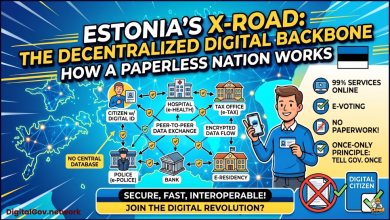
At its core, the DSN comprises two interdependent pillars: (i) a robust data exchange platform, such as Estonia’s acclaimed X-Road, and (ii) standards for unified citizen records. Together, these enable seamless, privacy-preserving data sharing while upholding principles like data minimization and citizen consent. The result? A government that operates more like a modern network than a bureaucratic machine—efficient, transparent, and responsive.
A data exchange platform alone is not enough; it requires harmonized standards for unified citizen records to ensure data is meaningful, consistent, and trustworthy when shared. This pillar establishes common frameworks for how citizen information is structured, identified, accessed, and protected—without forcing everything into one giant database.
The DSN’s power lies in integration. The data exchange platform provides the secure “pipes,” while unified citizen record standards supply the “contents” in a usable, governed format.
A tax authority, for instance, can instantly verify a citizen’s address from the population registry without paperwork—securely authenticated via digital ID and routed through X-Road-like infrastructure. This operationalizes the once-only principle at scale, slashing administrative burdens and enabling proactive, personalized services.
The Path Forward: Why DSN Matters Now
The Data Services Network is more than technology—it is a governance model for the 21st century.
As governments pursue AI, open data, and sustainable development goals, the DSN provides the trusted backbone: secure pipes for exchange plus standardized records for reliability. Nations like Estonia have proven it works; others—from the UK’s digital blueprint to emerging Digital Public Infrastructure initiatives—are moving in this direction.
By adopting the DSN framework, governments can move beyond digitizing paperwork to truly re-engineering public service delivery. Citizens gain convenience and control. Societies gain efficiency, transparency, and resilience. In a fragmented digital world, the Data Services Network offers a unified, future-ready blueprint—one where data serves people, not the other way around.