Estonia’s X-Road: The Decentralized Digital Backbone of a Paperless Nation
Estonia's X-Road is a decentralized, open-source data exchange layer enabling secure, interoperable communication between public and private systems without central storage, powering paperless e-services and handling billions of transactions yearly.

 In an era where governments struggle with siloed data, bureaucratic red tape, and cybersecurity threats, Estonia stands out as a global leader in e-governance.
At the heart of this digital success story is X-Road, an open-source software and ecosystem solution that provides unified, secure data exchange between organizations in the public and private sectors.
Launched in 2001, X-Road has become the invisible infrastructure powering Estonia’s e-Estonia initiative—enabling everything from e-Tax filings and e-Health records to e-Residency services—while embodying principles of decentralization, privacy, and interoperability.
Far from a centralized database or government-controlled hub, X-Road functions as a secure data exchange layer. It allows independent information systems to communicate seamlessly over the internet without storing data centrally, reducing single points of failure and enhancing resilience.
Today, it handles over 2.2 billion transactions annually across more than 3,000 e-services, connecting hundreds of databases and indirectly serving 52,000 organizations.
From Post-Soviet Challenge to Digital Innovation: The History of X-Road
Estonia’s journey into digital governance began in the late 1990s, shortly after regaining independence from the Soviet Union. By the end of the 1990s, the country had digitized many state registers, but they remained isolated silos. Data exchange was inefficient, insecure, and often manual.
A major 1996 data leak—where a contractor compiled and marketed a “superdatabase” of personal information from various government sources—underscored the urgent need for a secure, privacy-preserving alternative.
In 2000, advisor to the Prime Minister Linnar Viik spearheaded the X-tee (Estonian for “X-road” or “crossroad”) pilot project. Financed by multiple ministries and coordinated by the State Information Systems Department, the pilot connected just three databases using the XML-RPC protocol.
Developed by a small team including Tanel Tammet, Hannu Krosing, and Vello Kadarpik, it was publicly demonstrated that year. The full system launched nationally on December 17, 2001, under the leadership of the Estonian Information System Authority (RIA) and with key contributions from companies like Cybernetica.
Early versions focused on core needs: standardized interfaces, open-source principles, and strong security. Over the years, it evolved through multiple iterations—from XML-RPC in Version 1.0 to SOAP-based protocols, asynchronous services, and enhanced federation capabilities.
By 2014, Estonia shared the technology with Finland. A pivotal moment came in 2017 with the creation of the Nordic Institute for Interoperability Solutions (NIIS), a joint organization with Finland (and later Iceland) to oversee core development. NIIS took full responsibility in 2018, the same year Estonia and Finland established the world’s first X-Road Trust Federation for cross-border data exchange.
X-Road’s open-source code (now hosted on GitHub under the Nordic Institute) has made it a global digital public good, adopted and adapted far beyond Estonia’s borders.
How X-Road Works: A Decentralized, Secure Exchange Layer
X-Road is best understood as a “centrally managed distributed Data Exchange Layer (DXL).” Unlike traditional systems that route everything through a central server (creating bottlenecks and risks), X-Road enables peer-to-peer communication between organizations’ information systems.
Here’s the basic architecture:
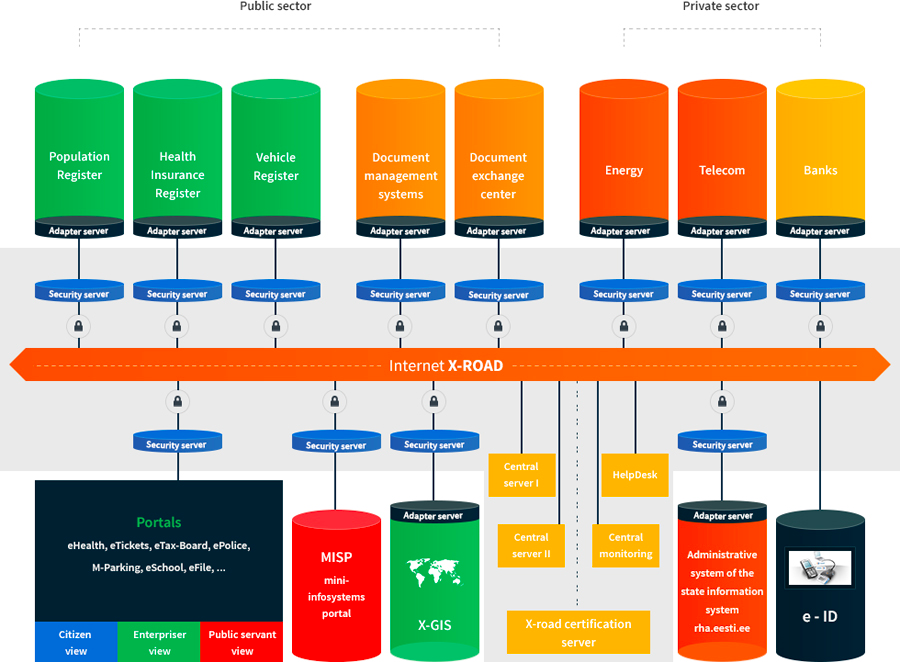
- Security Servers: Every participating organization (government agency, company, or even citizen-facing service) runs its own Security Server. This acts as the secure gateway—handling encryption, digital signatures, authentication, and logging for all incoming and outgoing messages.
- Central Services: A Central Server (operated by a trusted authority like RIA in Estonia) maintains a registry of members, their Security Servers, and access policies. A Configuration Proxy keeps all Security Servers synchronized without storing actual data.
- Data Flow: When one system needs data from another (e.g., a police database querying the tax authority), the request is routed securely via the Security Servers. Data never sits in a central repository—it flows directly from source to recipient.
Security is baked in at every level:
- Authentication: Organizations and users are verified with digital certificates from trusted Certification Authorities.
- Encryption: All communication uses end-to-end encrypted channels.
- Integrity and Traceability: Every transaction is digitally signed, time-stamped, and logged with evidentiary value (useful for audits or legal purposes).
- Access Controls: Fine-grained rights ensure data is shared only as permitted by law or consent.
This design supports the “once-only principle”: Citizens and businesses provide data once (e.g., via their e-ID), and authorized systems can reuse it efficiently without repeated requests. It also scales effortlessly—handling large datasets, multi-system searches, and even cross-border queries.
Transformative Impact in Estonia
X-Road is the glue holding Estonia’s digital society together. Public authorities maintain their own tailored IT systems, but X-Road makes them interoperable. Police can instantly access health or business registry data (with proper authorization), tax authorities pull verified income information, and citizens access services through the eesti.ee portal without filling out the same forms repeatedly.
The results are striking:
- Efficiency gains: Public sector employees save the equivalent of over 1,345 working years annually by avoiding redundant paperwork.
- Citizen-centric services: From filing taxes in minutes to viewing medical records or registering a business online, Estonia offers nearly 100% digital government services.
- Economic and social benefits: Digital identity and interoperability (including X-Road) contribute significantly to GDP savings and position Estonia near the top of the UN’s E-Government Development Index.
Crucially, X-Road strengthens digital sovereignty and cybersecurity. Its decentralized nature makes it resilient against attacks—no single breach can compromise the entire system—and its auditability promotes trust and accountability.
Global Adoption and the Road Ahead
What started as Estonia’s solution has become a model for Digital Public Infrastructure (DPI) worldwide. X-Road is now implemented in over 20 countries across Europe, Latin America, Asia, and beyond—including Finland, Iceland, Japan, Brazil, Mexico, Colombia, Cambodia, and others. Many have formed their own ecosystems or federations for cross-border exchange (e.g., Estonia-Finland real-time population register and taxation data sharing).
Similar technologies inspired by X-Road (such as UXP, PlanetCross, and Roksnet) have emerged in additional nations. NIIS continues to drive evolution: Version 7 (“Unicorn”) and the upcoming Version 8 (“Spaceship”) in 2026 promise to transform it into a full “dataspace” solution, further enhancing semantic interoperability and data value creation.
Conclusion: A Blueprint for Trustworthy Digital Government
Estonia’s X-Road demonstrates that secure, efficient, privacy-respecting data exchange doesn’t require sacrificing sovereignty or building massive centralized monoliths. By choosing decentralization, open standards, and strong cryptography from the outset, Estonia created a system that scales, endures cyber threats, and empowers both citizens and institutions.
As more countries grapple with digital transformation—balancing efficiency, privacy, and innovation—X-Road offers a proven, open-source blueprint. It’s not just technology; it’s a philosophy: data should serve people, not the other way around. In a world increasingly defined by data flows, X-Road shows how a small nation can lead the way toward a more connected, transparent, and sovereign digital future.
Featured Vendor: Cybernetica UXP
Expertise from building E-Estonia has been commercialized, led by vendors such as Cybernetica, who offer a repeatable X-Road solution capability, their ‘UXP’ – Unified eXchange Platform.
UXP brings together data from organisations, information systems, and databases. It provides crucial components for interoperability and data exchange in a secure and standardised way. UXP allows service providers to retain control over their systems and data, yet making them a member of an infinitely scalable and decentralised data exchange network.
The Government of Greenland set out to modernise public services by creating a secure data exchange platform – Pitu – a crucial step in its digital transformation. Cybernetica, as the prime contractor, deployed its UXP for them, enabling seamless and secure data sharing across key government systems.