NSW Leads Australia with Rollout of Secure Digital Birth Certificates
NSW has launched Australia’s first digital birth certificates for 16-21 year olds, providing secure, legally equivalent access via the Service NSW app.

 New South Wales has become the first Australian jurisdiction to make digital birth certificates (DBCs) available to the public, marking a significant step in the state’s digital identity transformation.
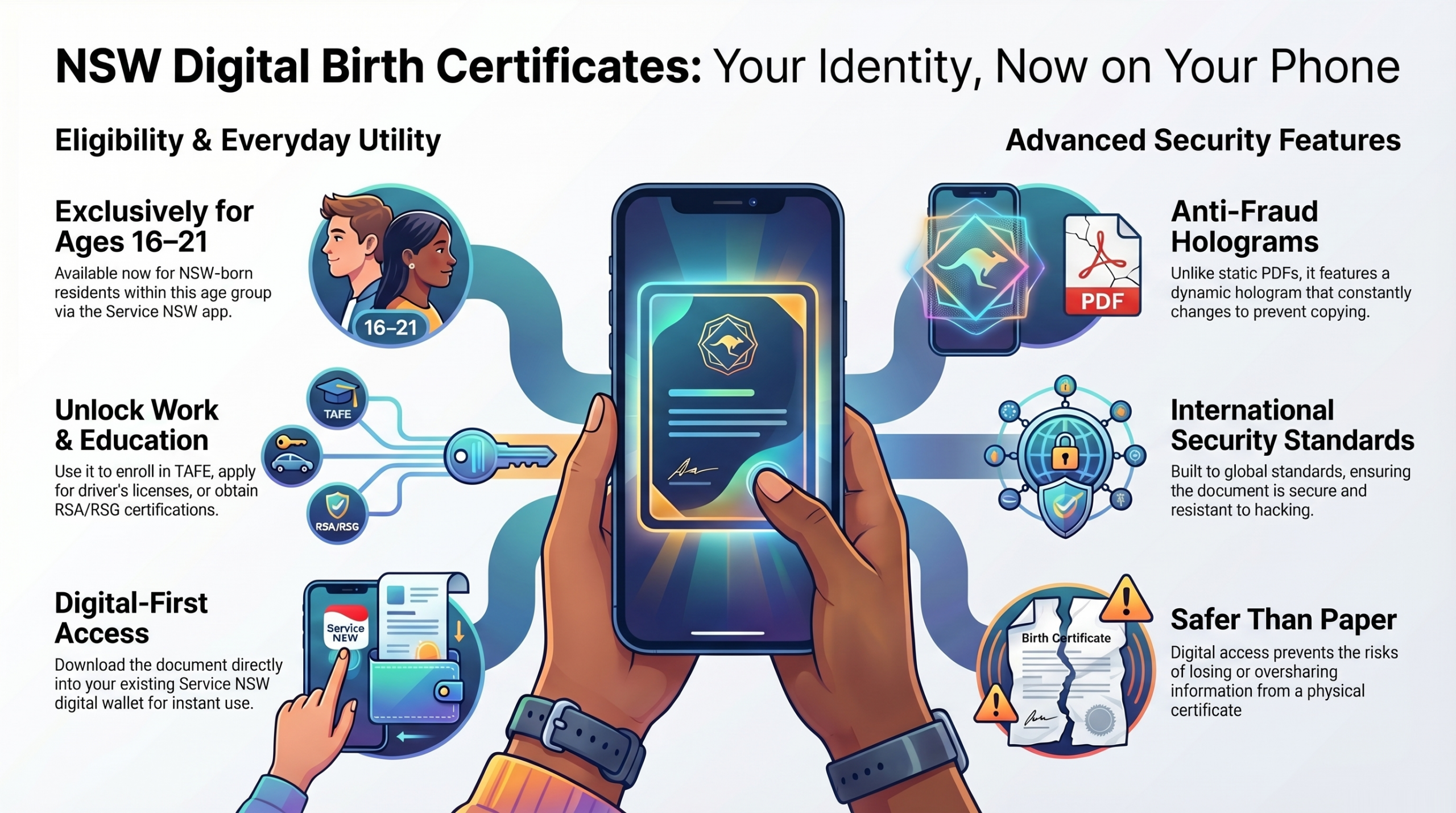
Launched on 17 March 2026, the initiative initially targets residents aged 16 to 21 born in NSW, offering a convenient, secure, and legally equivalent alternative to traditional paper documents.
The secure documents can be used for identity verification, employment applications, and obtaining licences including RSA and gambling certificates. The digital certificates feature enhanced security measures with changing holograms and data that cannot be reused or stored after verification.
|

Background and Phased Implementation
The Digital Birth Certificate builds on earlier pilots. In 2024, NSW tested the concept with newborns, and further trials refined the technology. A regulation passed in 2022 granted digital versions the same legal standing as paper certificates. The current rollout follows announcements in late 2025 and focuses on young adults who already hold a NSW Photo Card or driver’s licence.
Eligibility requires:
- Age 16–21.
- Birth or adoption registered in NSW.
- Possession of a valid NSW Photo Card or Driver Licence.
- A MyServiceNSW account.
The certificate is free during this initial phase and does not replace the physical document—it serves as an optional digital companion.
How It Works: Secure and User-Friendly
Users apply via a dedicated form on the NSW Registry of Births, Deaths & Marriages site. Upon approval (typically quick), they add the certificate to the Service NSW app’s digital wallet. The process integrates with existing identity verification, linking securely to the holder’s birth record.
Security features align with international standards, incorporating protections comparable to internet banking. The document supports selective information sharing, reducing unnecessary data exposure. It can include or link to biometrics for stronger verification. If the phone is lost or stolen, users can contact ID Support NSW for assistance. Updates to the underlying birth record (e.g., name changes) invalidate the digital version, requiring reapplication after syncing details with Transport for NSW.
Practical Benefits and Use Cases
For young people—especially those studying or working away from home—the DBC eliminates the hassle of locating or replacing lost paper certificates. Immediate applications include:
- Responsible Service of Alcohol (RSA) and Responsible Conduct of Gambling (RCG) competency cards.
- Other workforce licences.
- Identity verification for various NSW Government transactions.
In disasters, where physical documents are often lost or destroyed, digital access provides rapid identity confirmation for relief services. Broader adoption is anticipated across businesses, schools, clubs, and sporting organisations, with the government engaging stakeholders to expand acceptance.
Legal and Broader Context
Under the Births, Deaths and Marriages Registration Regulation 2025, the DBC carries equivalent legal weight to its paper counterpart, including a unique certificate number. It is not a certified copy for all purposes (e.g., some international uses may still require paper), but its status as an official identity document strengthens its utility.
This positions NSW ahead of other states. Victoria has conducted related pilots (e.g., for kindergarten enrolment), but NSW leads in public rollout. Internationally, similar efforts exist (e.g., Bahrain’s integration into government apps), reflecting a global shift toward verifiable digital credentials.
Challenges and Considerations
While promising, the phased approach highlights limitations. Current restrictions (age, name requirements, matching details) may exclude some users initially. Privacy remains paramount: strong cybersecurity partnerships address identity theft risks, but public education on digital hygiene will be essential. Expansion to other age groups depends on the success of this launch and further stakeholder feedback.
Businesses interested in verification will need guidance on integration, likely involving app-based scanning or API connections for seamless checks.
Future Outlook: Toward a Digital Identity Ecosystem
The DBC is part of a larger vision for integrated digital services in NSW. It enhances convenience, reduces administrative burdens, supports economic participation for young people, and improves resilience. As acceptance grows, it could enable more complex transactions with granular consent controls—aligning with principles of user-centric digital public infrastructure.
Minister for Customer Service and Digital Government Jihad Dib emphasized the convenience and security: “It’s the same as having a birth certificate in your pocket – but much more secure.” Service NSW Managing Director Greg Wells highlighted its value in everyday life and emergencies.
Conclusion
NSW’s digital birth certificate rollout exemplifies pragmatic digital government—leveraging existing infrastructure (the Service NSW app) to deliver tangible benefits while maintaining rigorous security and legal equivalence. For eligible young residents, it transforms a foundational identity document from a potential source of frustration into an always-accessible asset. As the program matures and expands, it may well set a national benchmark for how governments balance innovation, privacy, and accessibility in the digital age.
Eligible individuals can check availability and apply through the Service NSW website or app. Wider rollout details will be announced by the NSW Government as the initiative progresses.