 In an era of geopolitical tensions, data weaponization, and rapid AI advancement, nations must choose: rely on foreign platforms or build sovereign systems aligned with national values, laws, and security needs.
Sovereign Nation Infrastructure (SNI) integrates three core pillars—Sovereign AI, Digital Public Infrastructure (DPI), and Blockchain-based Digital Identity—into a resilient, citizen-centric digital backbone for governance, economy, and society.
This article outlines the conceptual foundation, architectural components, implementation roadmap, technical considerations, challenges, and real-world precedents for building SNI.
The Core Pillars
- Sovereign AI is a nation’s capacity to develop, train, deploy, and govern AI systems using domestic infrastructure, data, talent, and models. It relies on local compute (GPUs/TPUs in sovereign data centers), curated national datasets, and models fine-tuned or built from scratch to ensure compliance with local regulations and cultural contexts.
- Digital Public Infrastructure (DPI) consists of shared, open, interoperable digital systems that serve public needs at population scale. India’s India Stack (Aadhaar for identity, UPI for payments, ONDC for commerce, DigiLocker for documents) is the leading example: modular, API-first layers that drive innovation while preserving public oversight.
- Blockchain Digital Identity, especially Self-Sovereign Identity (SSI), gives individuals and entities control over their credentials. It uses decentralized identifiers (DIDs), verifiable credentials (VCs), and tamper-proof ledgers. Users store data in digital wallets and share it selectively via cryptographic proofs. Governments issue credentials without holding master copies, reducing breach risks compared to centralized databases.
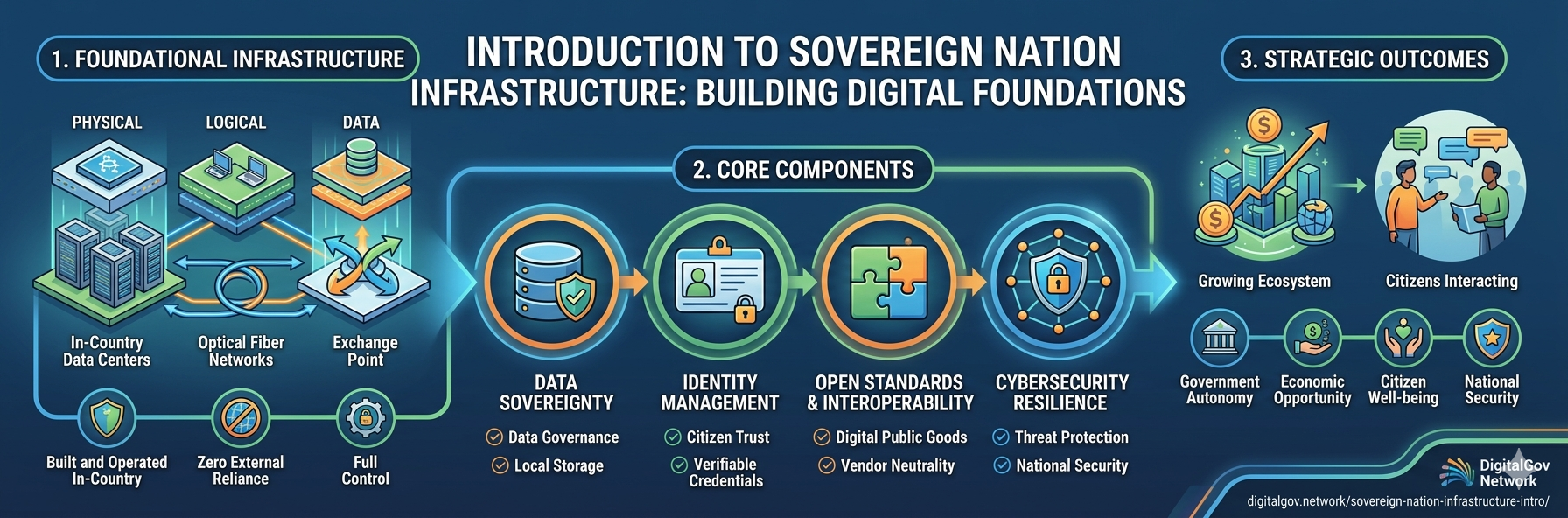
SNI is the deliberate convergence of these elements: DPI for scale and interoperability, Blockchain SSI for privacy and user agency, and Sovereign AI for intelligent, personalized, and automated services—all under national control.
Why SNI Matters
SNI delivers critical strategic advantages:
- Data and compute sovereignty — Protects sensitive citizen data and keeps AI under domestic laws.
- Resilience and security — Avoids single points of failure from global outages or sanctions.
- Economic competitiveness — Spurs local innovation, cuts tech imports, and enables new AI-powered services.
- Inclusion and trust — Provides portable, privacy-preserving identities alongside efficient services.
- Geopolitical autonomy — Strengthens positioning amid chip wars, data localization, and AI governance debates.
Nations without SNI risk becoming digital vassals; builders can export “digital public goods” and shape global standards.
SNI Services
Sovereign Nation Infrastructure unlocks a new generation of intelligent, privacy-first, and citizen-centric digital services that fundamentally transform how governments, businesses, and individuals interact.
Leveraging the seamless integration of Self-Sovereign Identity, DPI rails, and Sovereign AI, nations can deliver personalized services such as AI-powered virtual assistants that provide real-time guidance on benefits, taxes, healthcare, and education in local languages while accessing only the credentials the citizen explicitly permits.
Citizens can receive instant, automated approvals for loans, subsidies, or permits through verifiable credentials and AI-driven risk assessment, eliminating lengthy paperwork and intermediaries. Predictive public services become possible, including proactive disaster alerts with personalized evacuation plans, AI-optimized traffic and energy management, and preventive healthcare recommendations based on anonymized national data.
Entrepreneurs gain access to a trusted digital economy with instant business registration, seamless cross-border trade using verifiable credentials, and AI matchmaking for talent and capital. All services operate under zero-trust security with full auditability on blockchain, ensuring transparency without compromising individual privacy.
This results in dramatically higher inclusion, reduced corruption, faster service delivery, and the emergence of entirely new digital public goods that empower citizens as active participants rather than passive recipients in their nation’s digital ecosystem.
Architectural Blueprint
The architectural blueprint for SNI follows a layered, modular design that ensures interoperability and evolvability. At the base lies the foundational layer of sovereign compute and data centers, which are nationally controlled or operated through trusted partnerships. These facilities include air-gapped options for classified workloads, energy sovereignty through renewables and nuclear or microgrids, and hybrid cloud environments with strict data residency rules supported by confidential computing and hardware security modules.
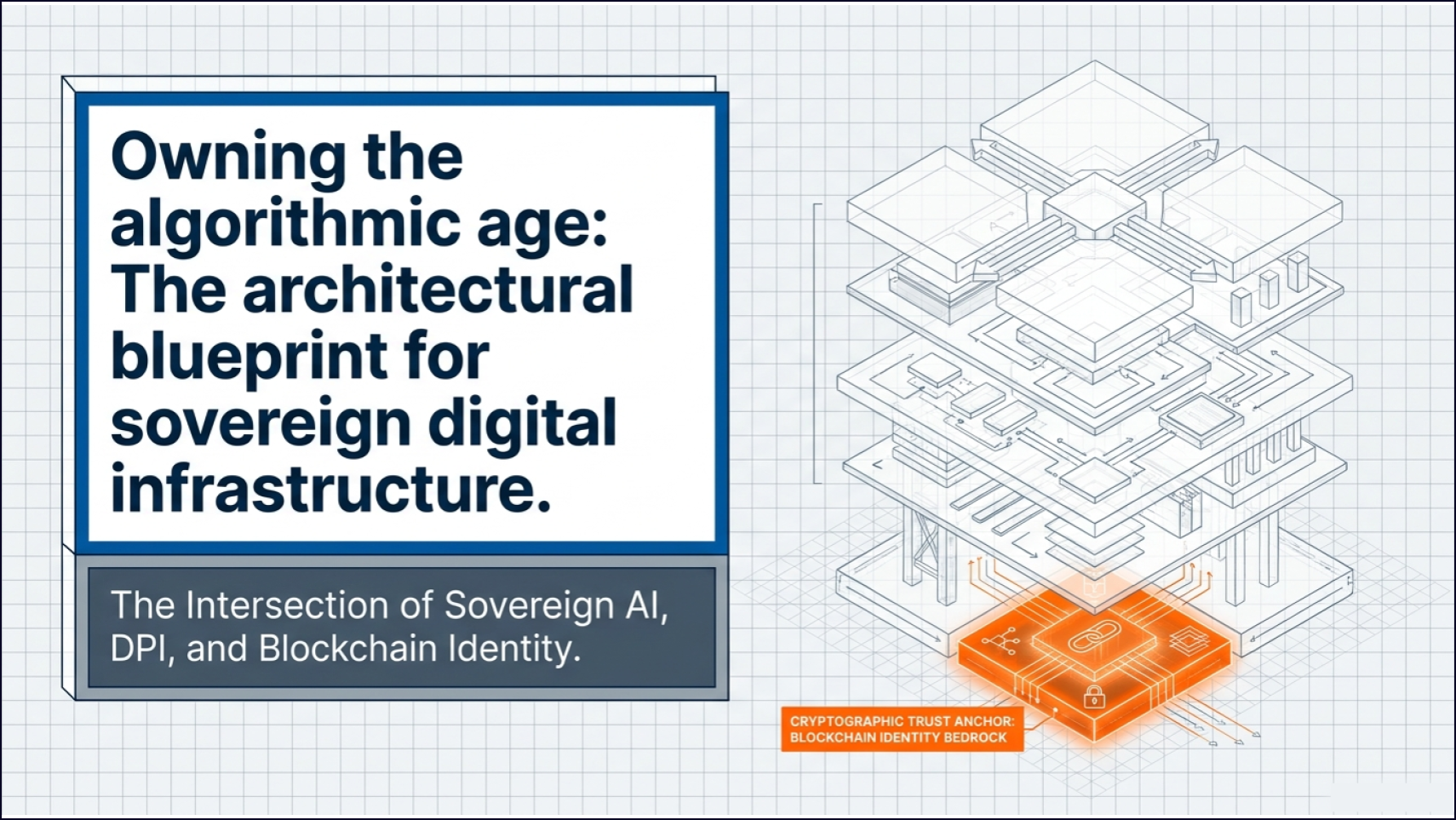
SNI uses a layered, modular design for interoperability and adaptability:
- Foundational Layer: Sovereign compute and data centers (nationally controlled or trusted partnerships), with air-gapped options, energy sovereignty (renewables, nuclear, microgrids), hybrid clouds, strict data residency, confidential computing, and hardware security modules.
- Identity Layer: Blockchain-enabled SSI with decentralized ledgers (public permissioned or consortium) anchoring DIDs and credential schemas. Governments issue foundational credentials linked to biometrics; citizens use mobile wallets with zero-knowledge proofs. Integrates with civil registries and standards like W3C DID/VC or eIDAS.
- DPI Core Layer: Interoperable rails for identity (augmented by SSI), payments, consent-based data exchange, and service delivery.
- Intelligence Layer: Sovereign AI models trained on anonymized DPI data (often via federated learning). AI agents support service orchestration, fraud detection, policy simulation, and citizen assistance, with ethics oversight, blockchain audit logs, and human-in-the-loop controls.
- Overarching Governance & Security: Zero-trust architecture, post-quantum cryptography, national PKI integrated with blockchain, regulatory sandboxes, open APIs with consent engines, and bilateral cross-border agreements.
Conclusion
Sovereign Nation Infrastructure is a strategic reassertion of national agency in the digital age. By combining Sovereign AI’s intelligence, DPI’s scale, and Blockchain SSI’s privacy and agency, nations can build systems that are secure, inclusive, innovative, and aligned with their citizens’ will.
Implementation requires vision, sustained investment, cross-ministerial coordination, and adaptive governance. Early adopters will safeguard their sovereignty and help define the next era of digital civilization—founded on trust, powered by intelligence, and owned by the nation.